Thursday, August 22, 2024

How to make a moonbase?


The moonbase can involve cabin modules that have life support systems. The problem in the moonbase is radiation and micrometeorites. Also, solar wind or plasma flow from the sun can cause problems in the cabins. When high-energy plasma impacts the moonbase it causes radiation and electric pikes. And that's why there should be some kind of magnetic system like high-power electric magnets. That can pull that plasma away from the moon base. 

In many models, there can also be a liquid hydrogen layer between manned module and space. The liquid hydrogen layer that is between the sun and the crew can absorb radiation effectively. Below the hydrogen layer can be space that denies hydrogen flow into the manned module. The hydrogen shell can be like a vault or "Chernobyl" nuclear site's sarcophagus around the manned modules. That structure's purpose is to protect the crew against the cosmic radiation. 

But the moon concrete is the key element in the building site. Moon minerals involve iron and titanium. The centrifugal isolator can be used to separate elements from each other. But the moon concrete can be used to make the shield against micro- and larger meteorites. The moon base must have a laser or some other system to protect it against meteorites. 

Engineers use concrete to make things that they want in normal building sites. But when engineers want to make moon stations. They face many problems. And one of them is that normal concrete does not fit on the moon. Moon minerals are suitable for moon concrete. But the difference is that the system uses melted minerals. 

"NASA and international partners are exploring microwave sintering to build a lunar base using local materials like ilmenite, enhancing construction efficiency by leveraging the mineral’s unique properties for rapid heating." (ScitechDaily, From Science Fiction to Reality: How Scientists Plan To Build a Lunar Base)

The laser or microwave systems melt the moon dust. And then the system makes brick- or Lego-looking structures.  Then the builders will put those Lego particles in the right form, and then lasers or microwaves melt those bricks into one homogenous structure. The moon bricks are made using melted moon minerals. 

The problem is: where the system gets energy. Solar panels can give electricity to the microwave systems. And lasers can use sunlight as a power source. The thing is that if there is some mineral that can fold microwaves, that thing can make it possible to create a microwave lensing system to melt moondust. 

The 3D printers can create those moonbases. The melted moondust is the raw material for those 3D-printed structures. The system melts the moondust using lasers, electric arcs, or microwaves and then drives it through the nozzle. 

In some possible scenarios, the iron-based moon silicate will be put in the moon dust. Then the microwaves will conduct to that mixture. And iron minerals can help the system to absorb electromagnetic radiation. 

But the thing is that maybe the hybrid systems are the best in that business. Laser systems and giant optical parabolic mirrors can make it possible to melt moondust in the daytime. Then at nighttime, the system can use nuclear-powered microwave systems to make the lava, which the system can model to the structures for the moon base. 


https://3dprint.com/113205/esa-3d-printed-moon-base/


https://scitechdaily.com/from-science-fiction-to-reality-how-scientists-plan-to-build-a-lunar-base/

The Ukrainian attack drones are shown their power.


Ukrainian military used drones successfully against the Russian targets. The sea drones have shown their capacity to strike against the Russian navy.  Those attack drones are transformed jet scooters and fast boats equipped with warheads. Those systems are shown their power, and the thing is that those systems are a very big threat in the wrong hands. The small, fast boats equipped with heavy anti-tank weapons and internal warheads are hard to see. And they are quite hard targets to defenders.

Things like hydrofoils that travel in very low depth make it possible for those systems can come to target from unexpected directions. That thing makes those systems dangerous in the wrong hands. It's possible to transform almost any speedboat in the world into a killer drone. The naval bases' security must re-estimate. 


The hydrofoil technology can make, at least drone submarines more effective. 


Once I saw a diagram of a miniature submarine equipped with hydrofoils. The name for that concept was Sea Cigar (?), but I might be wrong. The Sea Cigar is the idea for a miniature submarine that can travel fast on the surface and underwater. The idea is that the Sea Cigar is a regular submarine that can travel underwater using propellers. But that submarine has the hydrofoils that allow it to rise above the surface. The craft can use a similar technology as Swedish Candela uses. 

But when the system needs to drive very fast. The drone submarine can use jet- or even rocket engines that give it an incredible speed. The idea is that this kind of system can travel near the target as submerged. But then it can select if it attacks the surface or submerged. The system is capable of traveling fast both submerged and surface. And that makes it even more capable than present drones.


https://www.economist.com/science-and-technology/2022/12/07/ukrainian-ingenuity-is-ushering-in-a-new-form-of-warfare-at-sea

The new cargo systems take their innovations from the hydrofoils and WIG technology.


Above Candela P-12, (Image: Candela)

The new "flying hydrofoils" like the Swedish "Candela" can rise high above waves. That technology allows for a decrease in energy use and pollution. Electric hydrofoils use so-called passive hydrofoil technology. There the speed of the craft raises the hull above the sea on the wings, which are similar used in aircraft. 

Interesting visions this kind of craft can also operate using air propellers or even jet engines. Jet engines give those hydrofoils incredible speed. Those flying hydrofoils of high-lifting hydrofoils can use even rocket engines to give power. And that makes them interesting and an alternative for many missions. 


However, there is a possibility to make a hybrid hydrofoil. That connects wing-in-ground WIG technology with regular aircraft and hydrofoils. The variable wing geometry (VWG) makes it possible to create wings that can turn under the aircraft. The aircraft can operate as a hydrofoil, WIG aircraft. And as regular, high-flying aircraft. In some plans, the aircraft pushes the hydrofoils from below them. The DARPA concepts are not so radical. But the Liberty Lifter is interesting. 


One thing that caused the failure of the "Caspian Sea Monster" was the noise. It's possible. The next-generation flying boats can use regular boat propellers to travel outside the harbor. And those systems can travel to the outer sea before they start their jet engines. If the craft can have the possibility to act as hydrofoil. It can use regular blowers to travel short distances. And that ability makes that kind of system possible to travel far enough that the jet engines will not disturb people. 


"Artist's concept of Aurora Flight Sciences' design" (Darpa.mil, Liberty Lifter)


The DARPA's new "Liberty Lifter" program is based on the Cold War-era Soviet WIG designs. Those flying boats use the WIG technology, but the difference between the famous "Caspian Sea Monster" is that the Liberty Lifter has longer wings. The Caspian Sea Monster's short wings limited its operations above the sea. The Liberty Lifter can operate as a regular aircraft and flying boat. As well as WIG aircraft. And maybe as a hydrofoil. When Liberty Lifter carries extremely heavy cargo it can use the WIG or hydofoil mode.  


"A rendering of a General Atomics' Liberty Lifter proposal (Wikipedia, Liberty Lifter)


Those things are next-generation tools for cargo, people transportation, and military purposes. Flying boats that use hydrogen can have internal electrolysis chambers. And that system can get electricity from any electric source. 

Large-scale flying boats can also operate from regular airfields. But amphibious mode makes it possible to operate from coastal areas even if there are no airfields. Those systems can operate in anti-ship, anti-submarine, and even in regular bombardment missions. That means they can carry the same weapon systems as some strategic bombers. So they can have the same nuclear strike capacity as B-52. And that makes those systems interesting. 


https://candela.com/


https://www.darpa.mil/program/liberty-lifter


https://en.wikipedia.org/wiki/Caspian_Sea_Monster


https://en.wikipedia.org/wiki/Liberty_Lifter

Wednesday, July 31, 2024

New metamaterials make new data storage possible.


"Brookhaven scientists used their new ultrafast pair distribution function (uf-PDF) technique to explore the transition of a quantum material to a previously undiscovered material phase. The above schematic shows how the absorption of a laser photon initiates a small change that propagates through the material over time, rather than instantaneously changing the whole material. Credit: Jack Griffiths/Brookhaven National Laboratory" (ScitechDaily, Atomic ‘GPS’: Quantum Material Transitions Captured in First-Ever Atomic Movies)

In some old models, the quantum computer is two opposite hard disks. There would be the quantum points that the system puts oppositely. Then it shares information between those quantum points or quantum dots. And drives it to the other layer. 

New metamaterials and magnetic bubbles are revolutionizing data storage and computing. Before the computer can drive information into qubit, it must store it. In the same way, binary computers must store data before it starts to process information. 


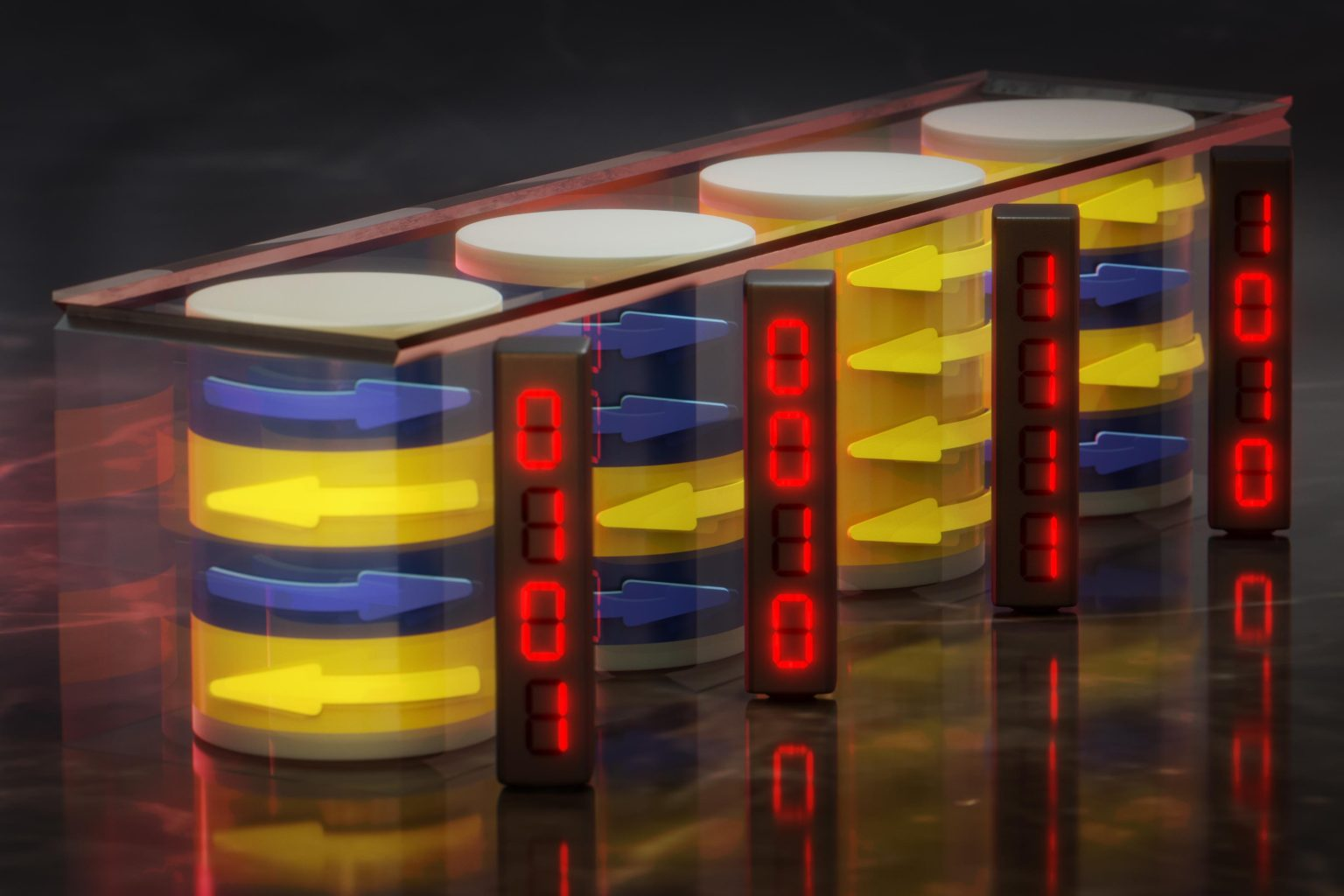
"Information is stored by the depth-dependent direction of magnetization in the domain walls, which are located between the cylinder domains and their surroundings. This magnetization of the domain walls can point clockwise or counterclockwise in the individual blocks, which are separated vertically by ruthenium layers. By systematically varying these directions, researchers can encode different bit sequences within a cylinder domain, as is shown here with some artistic interpretation. Credit: HZDR/Bernd Schröder" (ScitechDaily, Revolutionizing Data Storage: How 3D Metamaterials and Tiny Magnetic Bubbles Could Change Everything)

The error correction requires error detection. And in short operations, the computer can simply drive data twice through the system. But in long operations that can take months, the system can use two, or more data lines to make error detection, and the computer must make intermediate recordings for data, that travels in the system. 

The atomic GPS makes it possible to locate and manipulate atoms on graphene layers. The system can used to store data into the atoms or their magnetic bubbles. Then the system can start to transport information between atoms. Or, it can transport information between the most out electrons of two atoms. The system must lock those electron's positions, and then it can begin data transportation between them. 

The new systems can store information in the atoms in the graphene layer without the need to transport them physically. That makes the system more effective than that system, which should transport every single atom all the time when it transports information to that thing. 

In some versions, the system can create towers of magnetic bubbles. Then it can put those towers on the graphene layer. And start to create quantum entanglement between those magnetic fields. The ability to store data in the magnetic bubble makes it possible to transport it as a qubit. 


"Researchers at ETH Zurich, led by Pietro Gambardella, have developed a method to control the quantum states of single electron spins using spin-polarized currents, which could enhance quantum computing technologies. This new technique offers more precise, localized control compared to traditional methods using electromagnetic fields, potentially improving the manipulation of quantum states in devices like qubits. Credit: SciTechDaily.com" (ScitechDaily, Magnetic Qubits: Scientists Develop New Way To Manipulate Quantum States)

The system can make superposition and entanglement between those bubbles. Or it can shoot those magnetic bubbles through the track to the receiver. The system can also transport information between two bubbles adjusting their size. Information can travel between two identical magnetic bubbles. 

When the magnetic bubble transports its information, the system can destroy it after data transportation is done. That makes data transportation more secure.

The new metamaterials allow the system. That looks like neteye. The system can store data into magnetic particles, and hang those particles like atoms into the neteye. Then it can make the quantum entanglement between magnetic particles at both layers. That thing makes it possible to create a fast, multistate quantum system. 

The graphene network stabilizes qubits into that network. And then those systems can transport data between two layers. The ability to store data in atoms and their magnetic field makes it possible to create new solutions for binary and quantum computers. 


https://scitechdaily.com/atomic-gps-quantum-material-transitions-captured-in-first-ever-atomic-movies/


https://scitechdaily.com/magnetic-qubits-scientists-develop-new-way-to-manipulate-quantum-states/


https://scitechdaily.com/microscopic-building-blocks-new-dual-functional-supramolecular-structures-unveiled/


https://scitechdaily.com/revolutionizing-data-storage-how-3d-metamaterials-and-tiny-magnetic-bubbles-could-change-everything/


Friday, July 5, 2024

DNA can control non-alive processes.


"Visualization of the bridge recombinase mechanism highlighting the donor and target binding loops. Credit: Visual Science" (ScitechDaily, A “Word Processor” for Genes – Scientists Unveil Fundamentally New Mechanism for Biological Programming)

Maybe, quite soon we can use the DNA as a data store. 


“The bridge RNA system is a fundamentally new mechanism for biological programming,” said Dr. Patrick Hsu, senior author of the study and an Arc Institute Core Investigator and University of California, Berkeley Assistant Professor of Bioengineering. “Bridge recombination can universally modify genetic material through sequence-specific insertion, excision, inversion, and more, enabling a word processor for the living genome beyond CRISPR.”

"The bridge recombination system hails from insertion sequence 110 (IS110) elements, one of countless types of transposable elements – or “jumping genes” – that cut and paste themselves to move within and between microbial genomes. Transposable elements are found across all life forms and have evolved into professional DNA manipulation machines to survive. The IS110 elements are very minimal, consisting only of a gene encoding the recombinase enzyme, plus flanking DNA segments that have, until now, remained a mystery."(ScitechDaily, A “Word Processor” for Genes – Scientists Unveil Fundamentally New Mechanism for Biological Programming)

"Arc Institute scientists have discovered the bridge recombinase mechanism, a revolutionary tool that enables fully programmable DNA rearrangements. (ScitechDaily, A “Word Processor” for Genes – Scientists Unveil Fundamentally New Mechanism for Biological Programming)


"A team of researchers from the Arc Institute have discovered the bridge recombinase mechanism, a precise and powerful tool to recombine and rearrange DNA in a programmable way. Going far beyond programmable genetic scissors like CRISPR, the bridge recombinase mechanism enables scientists to specify not only the target DNA to be modified, but also the donor material to be recognized, so they can insert new, functional genetic material, cut out faulty DNA, or invert any two sequences of interest. Discover more in this short video visualizing the key aspects of the bridge recombination mechanism. Credit: Visual Science" (ScitechDaily, A “Word Processor” for Genes – Scientists Unveil Fundamentally New Mechanism for Biological Programming)

"Their finding, detailed in a recent Nature publication, is the first DNA recombinase that uses a non-coding RNA for sequence-specific selection of target and donor DNA molecules. This bridge RNA is programmable, allowing the user to specify any desired genomic target sequence and any donor DNA molecule to be inserted."(ScitechDaily, A “Word Processor” for Genes – Scientists Unveil Fundamentally New Mechanism for Biological Programming)


"Visualization of the bridge recombinase mechanism highlighting the transposon DNA and Genomic Target site. Credit: Visual Science" (ScitechDaily, A “Word Processor” for Genes – Scientists Unveil Fundamentally New Mechanism for Biological Programming)

Researchers created the nanoparticle, called quasicrystal using the DNA. That makes it possible to create structures using the DNA as the code. DNA-based material development is sometimes dangerous. There is the possibility that the DNA that controls the quasicrystal's growth slips into the human or some anima's cells. And that thing makes this kind of thing dangerous. The reason for that is that DNA controls every single process in every single cell. 

Researchers can create new organisms and give new abilities to old ones using DNA programming. The artificial DNA molecules can control the cell's electric processes. And that means those artificial electric cells can transfer information stored in the DNA to the computers. That transfer happens using electric signals that those DNA molecules control. 


Magnetic control of swimming direction of non-magnetic bacteria. a) Schematic illustration of the experimental setup. b) Snapshots of representative trajectories under four different magnetic field strengths. c) Swimming direction distributions. d) Nematic order parameter as a function of magnetic field strength for three different ferrofluid concentrations. e) Bacterial body orientation distributions. f) Inverse of body orientation fluctuations as a function of magnetic field strength. Credit: Communications Physics (2024). DOI: 10.1038/s42005-024-01707-5 (Phys.org, Getting bacteria into line: Physicists use magnetic fields to manipulate bacterial behavior)

"Researchers at Finland's Aalto University have found a way to use magnets to line up bacteria as they swim. The approach offers more than just a way to nudge bacteria into order—it also provides a useful tool for a wide range of research, such as work on complex materials, phase transitions and condensed matter physics."  (Phys.org, Getting bacteria into line: Physicists use magnetic fields to manipulate bacterial behavior)

The magnetic fields can control the movements of bacteria. 


The new way to combine AI and living bacteria can make a revolution in material research and medical research. Researchers put the bacteria swim in lines using magnetic fields. This thing allows the system to drive bacteria anywhere it wants. The small powerful nanomagnets can be used to control individual bacteria. 

But then we can think about possibly using genetically engineered bacteria that create enzymes as medicine. Genetically engineered bacteria can create medicines or researchers can use those bacteria to transport wanted genomes or DNA bites to the targeted cells. 

The genetically engineered macrophage can transport DNA to the non-wanted cells. And that allows researchers to create of systems that simply order targeted cells to die. In that case, genetically engineered microbes can transport the DNA bite that orders cells to die into targeted cells. 


"A mathematical tool called a fast Fourier transform maps the structure in a way that reveals the 12-fold symmetry of the quasicrystal. The fast Fourier transform of the electron microscope image of the quasicrystal is shown on the left, while the transform of the simulated crystal is shown on the right. Credit: Mirkin Research Group, Northwestern University, and Glotzer Group, University of Michigan" (ScitechDaily, Revolution in Material Science: Scientists Construct Nanoparticle Quasicrystal With DNA)

When we think about the possibility that the nanomachines build wanted DNA bites technology can someday increase human lifespan. The ability to connect DNA bites together can form hydride species. But the same technology makes it possible to create bacteria that can transform into another cell. So DNA transfer can make it possible to create bacteria that can transform into any tissue cell or neuron. 

That thing allows the bacteria that the magnetic system drives into a wanted position, and then the DNA transforms them to cells, that can fix damages in the body. The system can create bacteria, that turn into stem cells at the right moment. When we think about the possibility of creating cyborg cells that microchips control, we can think of the possibility of creating an artificial macrophage or B-cell that can remove DNA from the cell. 

And then replace that removed DNA using new DNA. That allows the system to renew wanted cells. When we think about the possibility of changing DNA in a large cell group, we can think of the possibility. That the genetically engineered bacteria can someday change old DNA from aging cells. Replacing that old DNA using new and fresh DNA. 


https://phys.org/news/2024-07-bacteria-line-physicists-magnetic-fields.html


https://scitechdaily.com/a-word-processor-for-genes-scientists-unveil-fundamentally-new-mechanism-for-biological-programming/


https://scitechdaily.com/revolution-in-material-science-scientists-construct-nanoparticle-quasicrystal-with-dna/

Thursday, July 4, 2024

Chinese innovative new cyborg uses human brain cells as controllers.


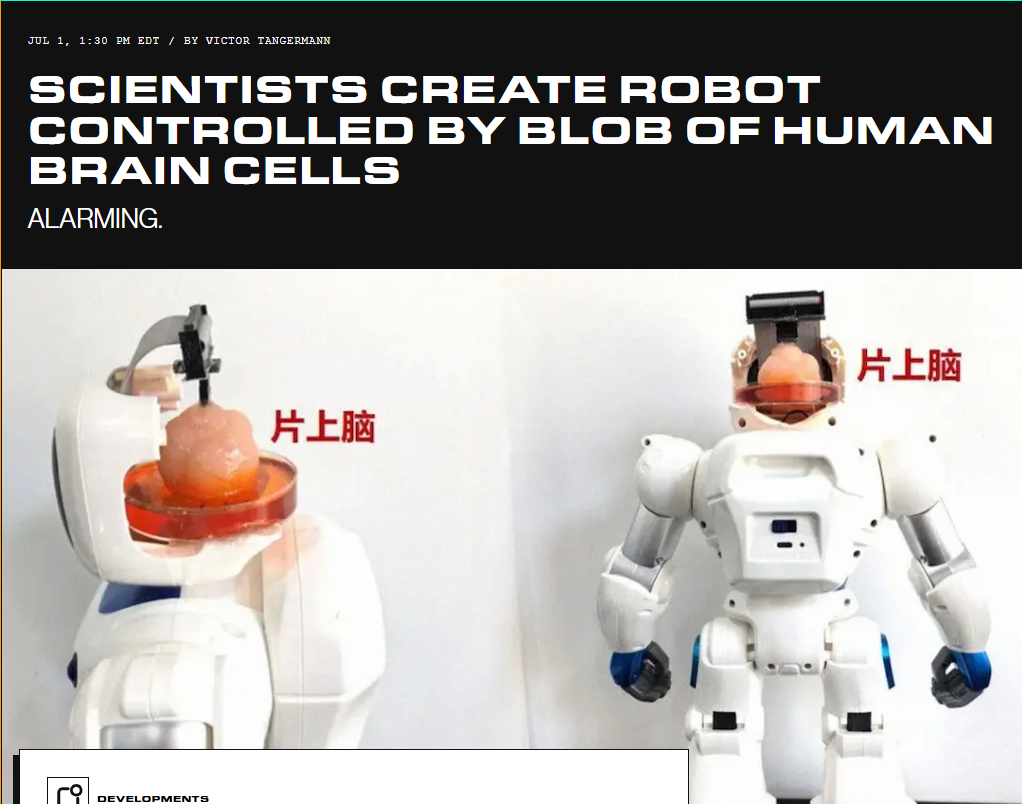
Above: https://futurism.com/neoscope/robot-human-brain-cells

The use of cloned brain cells is a new thing in robotics. Chinese researchers used cloned brain cells to make computers or control units for robots. These kinds of systems are new and fundamental tools. The ability to use human neurons as a computer opens an interesting and, at the same time, terrifying thing. 

It makes it possible to create robots and computers with the same intelligence level as humans. This kind of technology is the thing that can revolutionize robotics. And it can escalate into many other things.

The Neuralink-type neuro-implanted microchips and these kinds of tools bring those kinds of robots into reality. Cloned brains can installed on a robot body using a microchip, that connects to the computer that controls the robot body with living brain tissue. The system can be put into the occipital nerve. 


"A team of Chinese scientists used stem cells to build the brain and paired it with a computer chip that passes instructions to the robot's body that helps move its limbs, avoid obstacles and track targets" (https://www.dailymail.co.uk/sciencetech/article-13592197/Chinese-scientists-robot-powered-human-brain.html)

And it allows us to transmit neural impulses from the brains to the receiving microchip. That microchip can control the robot body or it can resend the information to the nervous system, that is below the neck. This is a suitable technology to restore the ability to move to people, who are paralyzed. 

The robot with living brains is actually, the brain in a vat. The robot system can involve a nutrient production unit. The system must feed brains with nutrients and protect that brain tissue against viruses and bacteria. The system must involve living bone marrow that allows it to create blood cells, that feed those neurons and defend them against bacteria. 

The living brain-controlled robots can have "local brains", which means every single robot body must have its life support system, that keeps those neurons alive. Bone marrow and blood cells require nutrients. So that they can feed those neurons. 

Or the brains can operate robots remotely using the internet. In that system brain in a vat is in the laboratory. The system is connected to the external body through the internet. The system can change the body that it wants to control very fast. And the robot bodies might also have remote-control abilities. That means robots are not like humans at all. 


https://www.dailymail.co.uk/sciencetech/article-13592197/Chinese-scientists-robot-powered-human-brain.html


https://futurism.com/neoscope/robot-human-brain-cells


Wednesday, July 3, 2024

New high-quality solid-state lasers can give a new boost to laser, and communication technology.


""The new laser leans against a block of titanium-sapphire. For scale, both sit atop a quarter. Credit: Yang et al., Nature" (ScitechDaily, Stanford Engineers a Pocket-Sized Titanium-Sapphire Super Laser)


The pocket-size titanium-sapphire lasers can revolutionize laser technology. This kind of solid and high-quality lasers can make a revolution in laser, drone, and quantum technology. 

One way to create a powerful laser is to use modular technology. In that system, the modular laser uses multiple independently operating lasers. And the system focuses those laser rays into one point. There are various ways to make that kind of system. If lasers are in the drone swarms, those drones can point all of their rays into one point. Another way is to make a cylinder, and in the middle of the cylinder is a laser ray. Then,  other lasers send their laser rays into that laser ray. 

In Star Wars movies the fictional Death Star uses that kind of laser system. And that technology can also used in drone swarms. The drone swarms can also make virtual cylinders. And then, one of the drones will shoot the collector laser ray through it. Then, other lasers will shoot their energy into that collector ray, which can reach a very high energy level. 

Modular laser technology makes it possible to create new types of quantum communication. In those systems, every laser can send information at the same time. But in different frequencies. That thing can make information more secure than without that technology. 

When we think about neural network systems like drone swarms, we must realize one thing. The single drone is a dummy, but as an entirety, the drone swarms can be extremely intelligent and independent. The virtual quantum computing mode in the drone swarms can operate like this: The system shares data bites with each drone. Then, those drones can collect that information into one entirety as quantum computers can do. That kind of information-handling system is a powerful tool. 

Laser technology allows drone swarms to operate in areas. There is powerful electromagnetic turbulence like plasma fields. In those areas, lasers offer secure and error-free communication applications. Small-size lasers that can cut metal, measure distances, and offer communication ability in one system make them multi-purpose tools. 


https://scitechdaily.com/stanford-engineers-a-pocket-sized-titanium-sapphire-super-laser/

Six clicks separate people from each other.

“A long-observed social phenomenon suggests that people across the globe are separated by surprisingly few connections. Credit: Stock” (Scit...