Thursday, June 27, 2024

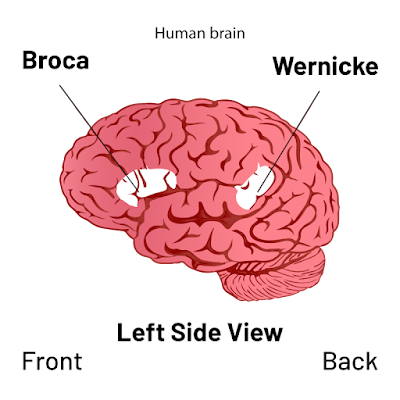
Complicated cooperation between Broca's and Wernicke areas.


Image Wikipedia, Wernicke's area


Which brain area should we observe? If we want to make the Brain-Computer Interface (BCI)? Maybe the best point would be the neural tracks that transport information to the facial and throat muscles from the sensorimotor brain lobe. The problem is that observing this kind of structure requires an extremely high accuracy. The complete BCI requires deep knowledge of the brain activity and its internal and external communication. 

The key role in communication is in the Broca's and Wernicke areas. But what area should we observe, if we want to transmit thoughts to the computer? Natural selection is the brain lobe that produces speech. Transforming speech to text and driving it to the AI is simple. But if we want to take that text straight from the brain, we must realize that speech is a product of the cooperation of multiple different brain lobes. And that is the key problem that BCI sensor creators must solve. 

The Neuralink chip observes the Broca area. That is the responsibility to produce speech. I sometimes write that we should hear Wernicke lobe rather than Broca. The reason for that is the Wernicke area is the brain lobe that understands speech. The third part that is required is the senso motorial brain lobes, which give orders to the facial and throat muscles that produce words. 

The interaction between the Broca and Wernicke areas is bidirectional. In old models, the information travels from the Wernicke lobe to Broca. The Broca sends orders to neurons that control the muscles that produce speech. That is a simple model. But things like aphasia research give information. The Wernicke plays a bigger role in speech production than previously noticed. 

The data travels between those three points in a more complex model than previously thought. That means the Wernicke lobe may check that the speech that Broca's area creates is something. That somebody understands. When Broca's area creates speech, it interacts with two other brain segments and collects data for the speech from memory blocks. The reason why the Broca is silent when people speak is its role as an information sender to the sensorimotor brain lobe. 

Broca's area must wait for those neurons' feedback after it sends the information. When the sensorimotor brain lobe sends feedback. it sends information back to Broca that received information. That feedback tells the Broca's area can release axons for the next mission. And if  Broca's area sends something during that feedback. There is a possibility that the neuron in Broca's area sends information to sensorimotor neurons using the same axon track. And that can cause disorder. 

But then researchers noticed. That while a person speaks. The Broca is shut. And that makes it hard to create a system that follows only the Broca area and turns speech to text, linking it to the interface. That thing means that the most promising areas that this kind of system should follow are Wernicke or sensorimotor area. The key element is that the system should listen to areas that handle complete communication. 


https://www.economist.com/technology-quarterly/2022/09/22/what-does-a-brain-computer-interface-feel-like


https://lonestarneurology.net/blog/brocas-vs-wernickes-aphasia/


https://www.ncbi.nlm.nih.gov/pmc/articles/PMC9058861/


https://www.sciencedaily.com/releases/2015/02/150218101839.htm


https://en.wikipedia.org/wiki/Brain%E2%80%93computer_interface


https://en.wikipedia.org/wiki/Broca%27s_area


https://en.wikipedia.org/wiki/Sensorimotor_network


https://en.wikipedia.org/wiki/Wernicke%27s_area


Monday, June 17, 2024

The new exoskeleton and rovers will revolutionize transportation.


The image above portrays the futuristic space suit. The artificial muscles and highly advanced technology make those systems extremely flexible. The system can use biologically cloned muscle cells. And highly advanced biological computers to control the suit. The claws on shoes can improve grip in difficult terrain. The intelligent brain-computer interface BCI systems communicate with those suits. The system can use cloned electric eel's cells to make electric  

The exoskeleton is a wearable robot, that can turn a human into a cyborg with extremely strong muscles. The exoskeleton allows that person to raise even a car from the ground. 

The exoskeletons can combined into space suits. That kind of AI-driven system can make it possible for a person to walk while sleeping. And that makes exoskeletons the basis for the new types of all-terrain suits. The exoskeletons are things. That makes it possible to create new types of transportation solutions.  


"Researchers have developed an AI-enhanced controller for exoskeletons that learns to support various movements such as walking and running without individual calibration. This system reduces energy expenditure significantly, making it a promising tool for enhancing human mobility efficiently." (ScitechDaily, AI and Exoskeletons Team Up to Transform Human Performance on Earth and in Space)


When researchers want to connect the exoskeleton with a space suit, that allows it to operate in highly radioactive places. Other places. Where heavy space suits can operate are deep-sea areas. And that can be the more powerful system in deep-sea operations. The problem with the so-called white space suit is their weight. And the exoskeleton can solve this problem. 


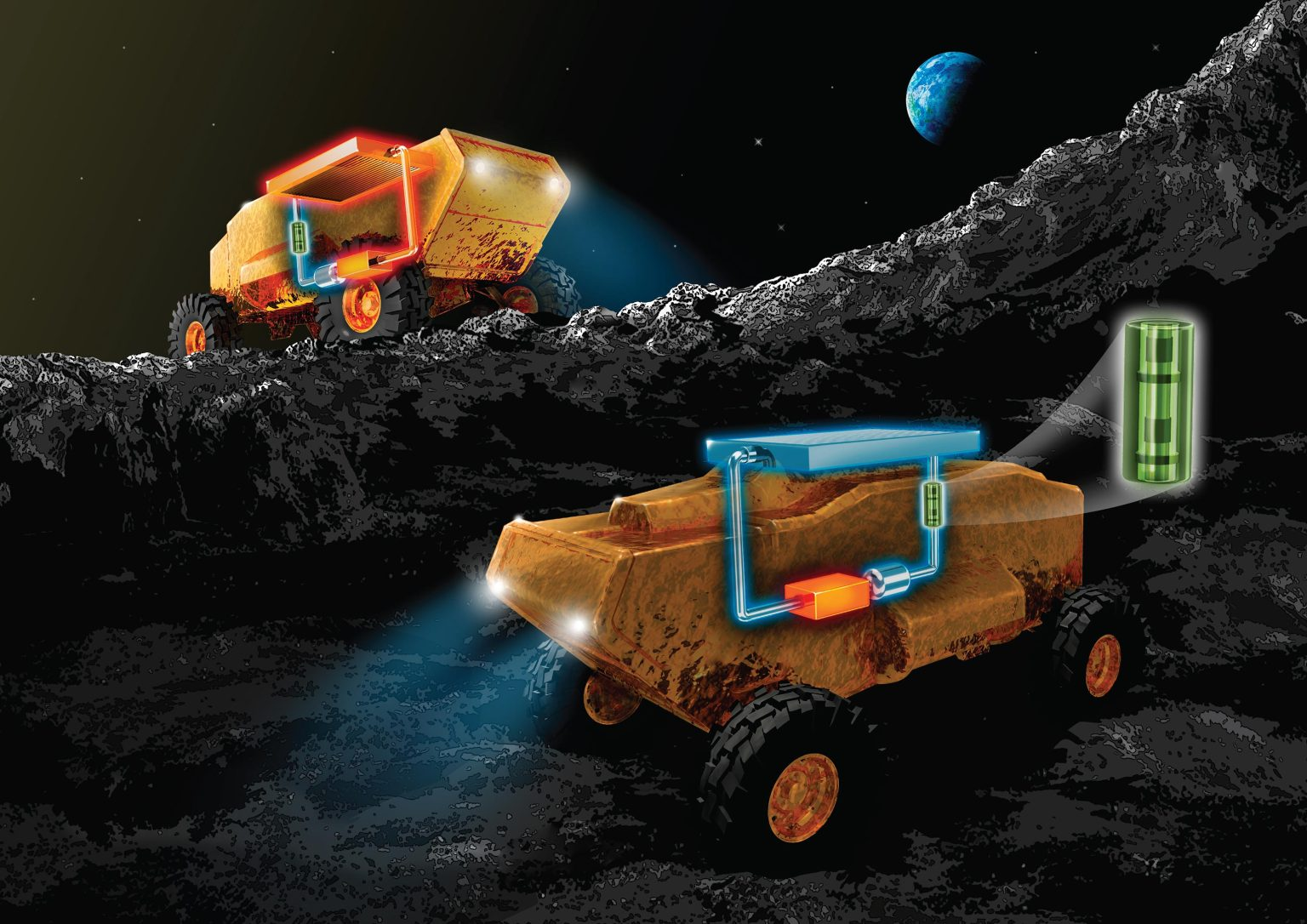
"Nagoya University’s new heat-switch device enables lunar rovers to efficiently manage extreme thermal conditions on the Moon, enhancing their operational lifespan and reducing energy use. Credit: Shinichiro Kinoshita, Masahito Nishikawara" (ScitechDaily, Revolutionary Rover Tech Tames Extreme Moon Temperatures)

The new rover systems can revolutionize transportation on other planets. And the same systems can also operate on the bottom of the sea. In some visions those, maybe truck- or Greyhound bus-size nuclear-powered vehicles can host moving laboratories. The same systems can operate underwater, and in some futuristic visions, those miniature submarines can carry torpedoes at the back of them. That allows it to trap bigger submarines from below. 

In some plans, the hovercraft-type solutions can travel on the moon. The system would make the air cushion using rockets. That is below the vehicle. Their size can be enormous because they must not land on Earth. All changes in cargo happen at the Earth orbiter. 

Those moon hovercrafts can also operate as shuttles between the moon and the Earth orbiter. The moon shuttle must only increase its rocket engine power. And then those engines raise the shuttle to the moon orbiter, and those shuttles turn to use their transit engines to travel to Earth. On Earth orbiter, their cargo will be loaded to conventional shuttles. And then the needed merchandise will be loaded to those moon shuttles, that return to the moonbase. 


https://scitechdaily.com/ai-and-exoskeletons-team-up-to-transform-human-performance-on-earth-and-in-space/


https://scitechdaily.com/revolutionary-rover-tech-tames-extreme-moon-temperatures/


Wednesday, May 29, 2024

Ukraine attacked against Russian long-range radar systems.


Image: (The WarZone,Strike On Russian Strategic Early Warning Radar Site Is A Big Deal)


The purpose of those attacks could be to open Russian aerospace for Ukrainian drones. The attacks against those radars were attacks against the Russian early warning system. And it affects Russia's ability to see incoming intercontinental ballistic missiles (ICBM). These kinds of attacks cause worries because if the Russian military loses its ability to detect incoming nuclear missiles, that can increase the possibility of making false detections about incoming missiles. And that raises the risk of global nuclear warfare. 


Image: (The WarZone,Strike On Russian Strategic Early Warning Radar Site Is A Big Deal)


The primary purpose of those radar systems is to detect enemy missiles and aircraft. But those radars can also have a weapon role. If the radar's transmitting power is high enough, that system can form the EMP pulse that destroys the electronics in the target area. The EMP pulses can also destroy radio transmitters and computers, and the high-power OTH radar can also be used to lock the GPS systems. High-power radars are excellent jammer tools. 

And as you can see, the OTH radars are multipurpose tools. If plus and minus radiation from two OTH antennas cross at a certain point, that thing can form electric arcs. Officially the "Voronezh M" uses about 0,7 MW power. But real power can be much higher. And if the radio waves from plus and minus poles impact it can form an electric arc. Or if the power is lower, that can cause a rise in body temperature. That kind of system can cause some kinds of symptoms. Or it can cause lethal injuries if the transmitter power is too high. 


"How a skywave OTH radar works: A powerful shortwave signal from a large transmitting antenna (left) reaches a target beyond the horizon by refracting off the ionosphere, and the echo signal from the target (right) returns to the receiving antenna by the same route. In practice, the beams are much closer to the horizon than shown here". (Wikipedia, Over-the-horizon radar)

From that image, you can see how the OTH radar works. All OTH radars work with similar principles. That means this image can used for modeling the OTH radars. The OTH system sends a skywave that jumps back from the ionosphere. Then that radio wave jumps back to the receiver. The only thing that limits this kind of system operation is the transmitter's power. For making long-distance, high-resolution images. The system requires very high transmission power. 


"Radio waves (black) reflecting off the ionosphere (red) during skywave propagation. Line altitude in this image is significantly exaggerated and not to scale." (Wikipedia,Skywave)


"Example of Skywave Propagation taken from PSK Reporter (Wikipedia, Skywave)

When we think about symptoms that some Ukrainian soldiers report, the reason for those symptoms can be some kind of poison gas. Or it can be some kind of acoustic or electromagnetic system that can warm or heat the nervous tissue. The electric arcs can used as acoustic wave sources. Or they can used to stress the nervous system. 

The thing is that it's possible. Those long-range over-the-horizon radars (OTH) can used to jam the GPS and Starlink systems by making radio signals that cover the GPS and data communication. The long-range radars can see targets over the horizon, and they can also support their artillery. The Ukrainian military forces attacked against "Voronezh M" radars that can see to even 8000 kilometers. The effective range of those systems is confirmed to be 6000 kilometers. 

But it's possible. Those OTH radars can see targets from 8000 kilometers away. The "Voronezh M" plays a key role in the Russian early warning system. If too many of those radars are damaged, that system's ability to see incoming missiles decreases. 


https://www.reuters.com/world/europe/ukraine-drone-targets-russian-early-warning-radar-record-distance-kyiv-source-2024-05-27/


https://www.twz.com/news-features/strike-on-russian-strategic-early-warning-radar-site-is-a-big-deal


https://en.wikipedia.org/wiki/Over-the-horizon_radar


https://en.wikipedia.org/wiki/Skywave


https://en.wikipedia.org/wiki/Voronezh_radar


Monday, May 27, 2024

Russia shot a suspected space weapon into an orbital trajectory.


There is suspicion that the Russian new satellite (Cosmos 2576) is an ASAT weapon. The mysterious satellite is in the same orbiter as a U.S. government probe. And there is suspicion that this Russian probe involves some kind of kill vehicle like kinetic energy weapons or even a nuclear warhead. The nuclear warhead is one of the most feared weapons in space. In too many scenarios, the nuclear attack begins with a nuclear explosion in space, whose purpose is to knock out electric systems by using the electromagnetic pulse (EMP). 

The EMP pulse can destroy aircraft and computers and damage other electronics and electric networks. In some visions, the EMP weapon is hidden in the satellites, which can detonate at low orbiter. The EMP weapon can wait in the high orbiter, and when it takes order, it can transport the weapon to the lower orbiter. The spaceborne nuclear weapon can destroy many satellites. And this is the reason why those systems are prohibited. 

One version of the space nuclear weapon is the laser system, where a nuclear weapon pumps energy. The nuclear elements are around or near the laser. Then that nuke will detonate, and the laser aims the light to the ground. This kind of laser can be dangerous to ground targets even if they are single use. The nuke will vaporize that laser immediately, but that system destroys many satellites around it. 


There is suspicion that the Russian space weapon is a dummy nuclear weapon. If the protection of that weapon is not strong enough. The hackers can break its launching codes. And in that case, it's possible. That some hackers can detonate that weapon. 

The Soviet Union tested killer satellites and their control systems in their Almaz program.  The Almaz was a highly secretive military space station program, there the Soviets tested military space applications including weapon solutions. The satellites equipped with machine guns or simply made collide with each other. Those tests and research work continued after the 1967 treaty that banned space weapons. 

The killer satellites were planned to be used against things like military communication and recon satellites during the war. And that should deny the submarine-launched ballistic missile (SLBM) submarines getting their launching codes. The GPS satellites also planned targets for the killer satellites and ground-based ASAT systems. 

The analysis of the effects of space nukes is based on data collected mainly from high-yield nuclear tests Hardtack 1 Teak, and Orange in 1958. And Operation Dominick, 1962. In a nuclear test codenamed "Dominick Starfish Prime" on 9 June 1962, the U.S. military launched a 1450 kt (about 1,5 mt) nuclear weapon over Honolulu. The altitude of that test is reported 248 miles (about 400 km). 

And that EMP pulse closed electric circuits in Honolulu city. This test shows how powerful spaceborne nukes can be. And today electricity is more sensitive than in 1962. There were also smaller nuclear tests in high atmosphere like the "Argus" test series, that tested the small nuclear weapon's ability to create plasma shield over targets. 


https://arstechnica.com/space/2024/05/russia-still-appears-to-be-playing-cat-and-mouse-with-us-spy-satellites/


https://futurism.com/the-byte/pentagon-russia-orbital-weapon


https://www.msn.com/en-us/news/world/space-warfare-russian-satellite-killer-weapon-now-tracking-u-s-tech-pentagon-warns/ar-BB1mVqNO?ocid=BingNewsSerp


https://www.nuclearweaponarchive.org/Usa/Tests/Argus.html


https://www.nuclearweaponarchive.org/Usa/Tests/Dominic.html


https://www.nuclearweaponarchive.org/Usa/Tests/Hardtack1.html


https://en.wikipedia.org/wiki/Almaz


Friday, April 26, 2024

What if we establish Venus's base and search for possible lifeforms from that planet?


"A new paper argues that studying Venus, despite its inhospitable conditions, is crucial for understanding the potential for life on other planets and predicting Earth’s future. It outlines the similarities and differences between Earth and Venus, highlights the importance of understanding Venus’s atmospheric and geological conditions, and explains upcoming NASA missions aimed at gaining more insights. " (ScitechDaily, Scientists Turn to Venus in the Search for Alien Life)

The research underscores the necessity of using Venus as a model to make accurate assumptions about life on distant planets and to contemplate the long-term fate of Earth. Credit: SciTechDaily.com" (ScitechDaily, Scientists Turn to Venus in the Search for Alien Life)


Venus can be a more suitable harbor for extraterrestrial life than Mars. 


There may be some primitive lifeforms on the planet Venus. Those lifeforms can hover in their sulphuric acid clouds. Or they can live in Venus' mountain area like Maxwell Montes. 

It's possible. Those still hypothetical lifeforms can be like bacteria, that make sulfur powdery mildew from sulphuric acid. That bacteria could live on the dark side of Venus, and it's possible. Those bacteria could turn themselves into spores at dayside as anthrax bacteria make on Earth. Those bacteria spores could hover in clouds much longer than. 

They could hover on Earth. Venus's atmosphere is much denser than Earth's. And it's different. Carbon dioxide is a heavier gas than oxygen and nitrogen. The atmosphere is also flat, which means it starts to turn denser at lower altitudes than Earth's atmosphere.

But the highlands are more comfortable. And it's possible that sometime in the future. Humans will build a base on Venus's highlands or hover base in its atmosphere.


Artist's rendering of a NASA crewed floating outpost on Venus (Wikipedia, High Altitude Venus Operational Concept)


Suggested specifications for the robotic airship (Wikipedia, High Altitude Venus Operational Concept)


Another HAVOC concept.

"Slide detailing sequence of events for the crewed descent (Wikipedia, High Altitude Venus Operational Concept)


The High Altitude Venus Operational Concept (HAVOC) program. 


In 1971 the Soviet engineer and Sci-Fi writer Sergei Zhitomirsky introduced the idea of the "Venus islands". Those islands would be airships in Venus's atmosphere. 

Venus's atmosphere is a carbon monoxide or carbon dioxide-based place, where lead will melt. In some visions, there could be liquid lead ponds on Venus's surface. Carbon dioxide is a very heavy gas. And on Venus, we could fly by using nitrogen balloons. The High Altitude Venus Operational Concept (HAVOC) program is the plan to make a hovering base in Venus's atmosphere. 

In some visions, the HAVOC base could be the quadcopter that acts as a platform that hovers in the atmosphere. The system can use a long tube. That makes the capillary pull through the generator. This system can hover in Venus's atmosphere because it's denser and carries that craft better than Earth's atmosphere. Nitrogen and oxygen are lighter gas than carbon dioxide. Also, a copy of Earth's atmosphere makes lightweight structures hover in Venus's atmosphere. 

The program plan is to send the airships to Venus's atmosphere. Those fully automatized systems can predict manned bases at Venus's clouds. Or in its highlands. 

Manned base on Venus's highlands can be like regular houses. But the life support system requires carbon monoxide filters. The structure must have thermal protection structures. Venus's colonists can use similar protective suits that the people who work in steel factories use. 

The carbon filters can remove carbon dioxide from Venus's atmosphere before the life-support systems drive that cleaned gas to the crew cabin. The crew must stay in those mountain areas, where the temperature is lower than on Venus's surface.

One purpose of that futuristic Venus base could be to terraform that planet. In that case, the colony creates the genetically engineered bacteria to remove oxygen from carbon dioxide. That should decrease the temperature on that planet's surface and lowlands. But those visions are far away in the future. 


https://spectrum.ieee.org/nasa-study-proposes-airships-cloud-cities-for-venus-exploration

https://scitechdaily.com/scientists-turn-to-venus-in-the-search-for-alien-life

https://nasa.fandom.com/wiki/High_Altitude_Venus_Operational_Concept

https://en.wikipedia.org/wiki/High_Altitude_Venus_Operational_Concept


https://setiandfermiparadox.wordpress.com/2024/04/26/what-if-we-establish-venuss-base-and-search-for-possible-lifeforms-from-that-planet/

Thursday, April 25, 2024

Acoustic wormholes and long-distance ion beams can be the next-generation tools.


"Artist’s impression of optoacoustic computing. Credit: Long Huy Da" (ScitechDaily, AI Efficiency Breakthrough: How Sound Waves Are Revolutionizing Optical Neural Networks)


Acoustic wormholes and long-distance ion beams can be the next-generation tools. 


Acoustic systems can revolutionize optical networks. 


The acoustic beam means energy or particle beam, where energy travels in or between molecular-size structures. The term acoustic laser means the coherent soundwave that travels in the air. The reason why researchers are interested in acoustic systems is that those systems transmit cold energy. The acoustic systems can play molecule billiards. And researchers can use them to assemble nanomachines. 

The U.S. military and police's LRAD (Long Range Acoustic Devices) are one example of acoustic lasers. In "acoustic lasers". The acoustic system pushes the soundwave into a very thin form. Some acoustic systems use diamonds to make powerful, highly accurate, and thin sound waves. This kind of system makes it possible to cut even metals with a very high accuracy. 

Acoustic waves can also transmit digital data. The acoustic system can send acoustic waves to the piezo crystals. That can transform them into digital form. The LRAD systems also can make it possible to send very accurate binary data through air. The system itself is a modem. That is connected to the acoustic lasers. Accurate acoustic systems can used to create highly accurate sonars. 

If the sonar system uses LRAD technology it can create powerful soundwaves that are invisible from the sides. The highly accurate acoustic systems can create a powerful acoustic wave that can break even metals. This kind of system can turn the sonar system into a weapon, that breaks the submarine shell. 

Acoustic systems can make it possible to send qubits through the air. In those cases, acoustic systems can drill holes in the air. The system can use things like acoustic diamonds to make the acoustic tornado, which makes the vacuum channel through the air. The acoustic systems can also transport energy in the small piezo-crystals. And that thing can help to control the miniature LEDs. And other kinds of systems. 


Acoustic wormholes. And Tesla's death ray. The acoustic wormholes can make it possible to give long-distance antimatter injection to the target. 


The Tesla's death ray could be an acoustic wormhole through the air. Or it might be the electron beam, artificial lighting, that travels through an artificial eruption channel. The coherent micro- or radio waves can create that eruption channel. That helps to aim an electron beam at the target with a very high accuracy. 

But, if we want to make a long-distance shot in the atmosphere, we must create a vacuum channel through the air. Ions do not travel long distances in the air, because they hit air molecules. And those impacts neutralize those ions. That means the ion beam is not dangerous in the air. The acoustic wormholes or vacuum channels through the air make the ion beam unable to release its energy. And if the system shoots protons in the electron rays those protons keep those ion beams in their form. 

The acoustic wormhole or vacuum channel or vacuum tunnel through the air makes it possible to send long-distance antimatter beams through the air. The system must only deny the antimatter touch with the regular material. If that thing is possible. The antimatter ion cannon is possible. 

It's possible to shoot antimatter ions to the target through the air. If there is a vacuum channel that denies the antimatter ion touch the air molecules. The antimatter ion beam that travels in acoustic wormholes can give the possibility to send highly accurate anti-matter impacts to the target. And that system can make the antimatter-ion cannons the next-generation replacers for nuclear weapons. 

The acoustic systems can used to make the ions travel longer distances in the air. If researchers connect the acoustic system to the lasers. It can used to make acoustic wormholes. In those systems, the laser creates a vacuum channel through the air, and then the acoustic system creates the sound tornado around that channel. That acoustic tornado closes the vacuum channel in it. And the acoustic tornado denies outcoming air to fill that channel. 

The acoustic wormhole can make Tesla's death ray true. The ion cannons can shoot ions and anions through those channels. If there are positive ions in the electron beam. That electromagnetic pull keeps the beam in its form. The acoustic system can make it possible. That the ions and electrons can travel in the vacuum channel. In the channel must be two internal acoustic beams that deny the electron touch with protons. And that makes it possible to shoot ion beams in long range. The system must only deny the ion touch with air molecules. The system must separate negative and positive components. 

Maybe Nikola Tesla's original idea was simpler than this. The idea could be that the death ray system creates the eruption channel through air. The maser (Microwave amplification by stimulated emission of radiation) or coherent radio waves can create an ion channel through air. That channel forms the artificial eruption channel through the air. Then the system can release an electron beam through that channel. 


https://scitechdaily.com/ai-efficiency-breakthrough-how-sound-waves-are-revolutionizing-optical-neural-networks/

Sunday, April 7, 2024

Bio- or nature-inspired robots are next-generation tools.


Things like ants can be models for the next-generation drones and drone swarms. The ant-shaped robot can be car-size or it can be ant-size. Larger robots can act as bases for smaller-size robots. In some visions, larger-size robots can build new robot insects. Those robots can interconnect their microprocessors into the neural network. 


There are two ways to make nature-inspired robots. 


1) The robot can be a miniature machine. That uses non-organic technology. 


2) The system can use the real insects or other animals that it takes into control. 


And those entireties can be very independent. In that model, those small-size robots can operate as an entirety where they share their sensorial data and microchip capacity. The new 2D semiconductors are tools. That can make very small and low-voltage microchips possible. Those microchips can control small insect-shaped or cyborg insects. 


The reptilian-shaped robots can look like real lizards. They can use fuel cells that use methane or alcohol as fuel. Or the surgeons can install the microchip in the lizard's brains. For working perfectly. That system requires complete information about the lizard's brain activity. Then the system can decode data from the lizard's brain. Interacting implants can control lizards like robots. 

When microchips take the insect under control. The system simply connects the microchip to the insect's shell. And then the system uses electric stress to control insects. New decoding systems can make the system see what insect sees. The system can decode the signals from an insect's nervous system, and make operators see what it sees from the computer screen. 

The Neuralink-type systems can turn all animals into robots. The implanted microchips can used to control animals. Like birds, reptilians, fishes, whales, and other kinds of things like monkeys. It's possible. The microchips can connect to animal skin on their brain. And that system can control the animal's nervous system. 


https://meche.mit.edu/featured-classes/bio-inspired-robotics


https://www.msn.com/en-us/news/technology/inspired-by-nature-researchers-engineer-smart-swarms-of-miniature-robots/ar-BB1l4GNi


https://roboticsbiz.com/bioinspired-robots-top-20-robots-inspired-by-animals/


Six clicks separate people from each other.

“A long-observed social phenomenon suggests that people across the globe are separated by surprisingly few connections. Credit: Stock” (Scit...