Wednesday, March 5, 2025

Biohacking is the most game-changing technology in the world.


"A research team has identified NEAT1, a long non-coding RNA, as a key player in DNA repair. This discovery links RNA metabolism to genome stability and opens up potential new cancer treatments. Credit: SciTechDaily.com" (ScitechDaily, Scientists Just Discovered an RNA That Repairs DNA Damage – And It’s a Game-Changer)

Humans make evolution faster than ever before. We created many species like dogs and cows to serve us. The tame pig has many united things with the wild boars. But the tame pig is not anything like wild boards. The human removed aggression from that species. Same way dogs are far from their natural cousins wolves. Tame cattle are also processed from the wild bulls. 

The thing. What makes tame cattle different is that aggressive individuals cannot make descendants. Aggressive cattle will be sent to a meat factory. And that removed aggressive behavior. 

But today humans have the tools that we had not before. Those tools are genetic engineering and nanotechnology. They can create any creature in the world. We can create artificial DNA that can create artificial species that are not in nature. Creating artificial individuals is similar to breeding horses. The researchers must find individuals who have certain abilities. Then they can enrich the genetic material. However, that method is limited to the species. 

But nanotechnology and genetic engineering make it possible to connect genomes between species. That makes it possible to create even humans whose skin involves chlorophyll molecules. 

Researchers can create artificial species and modify individuals' hereditary benefits. The imagination in biological and genetic research is the limit of biotechnology. The ability to give genome therapy is similar to giving vaccines to people. We can say. That vaccines are early-stage for a large-scale gene therapy. In the morula stage, researchers can check the DNA and then remove things like hereditary diseases from it. The same technology that makes humans wealthier is the worst nightmare in the wrong hands. 

The problem with large-scale genome therapy is there are so many cells in the human body that the system has no time to change the DNA into those cells.  

One of the answers is to create a virus that infects lots of cells. The virus can turn lots of cells to create the wanted DNA. And then. They can inject that DNA into their neighbor cells. 

The DNA bite can be like a program that creates the virus for a certain time. Then. That DNA will destroy the sequences that create those viruses. The problem is that in the genetic transfer process, the old DNA must be removed. If that is not done the result is catastrophic. 

The ability to change the DNA sequences helps to remove hereditary diseases, but it also makes it possible to order the gender of the individuals and connect the other DNA into those sequences. If we connect the genomes from gorillas to the human muscle cells, that gives the ultimate strength for a person.

So maybe we can make Albert Einstein with muscles that make Arnold Schwarzenegger look like rickety. Or we can create a creature that can adjust its muscle-cells mitochondria mass. But then another game-changing thing is that researchers found the RNA that can fix the DNA. RNA can be game-changing in the aging medicals. Aging and some cancers are results of DNA damage. And the ability to fix the DNA. Removes some of those damages. 

The RNA that fixes the DNA can increase our lifetime. And that is one of the things. Why RNA is important. 

This type of RNA can also used to fix the DNA-based nanomachines. When we talk about lifetime. And other things we must realize one thing. Those therapies are not so ultimate that we can forget exercise, a wealthy lifestyle, and being careful. 

One of the reasons why our lifetime will not extend as predicted is that medicines and treatments are better than ever before. So, there are people who think that they can live without caring about a wealthy lifestyle. Some people believe that even if they smoke a couple of boxes of cigarettes every day, and drink a couple of beers every day will get treatment when they want. 

One of the things in medical treatment is that. People don't take medicines as they should take them. If the antibiotics are interrupted before the medication is ended that leaves the strongest bacteria alive. And that is the origin of the super bacteria. This means wrongly used antibiotics and other medicines increase the speed of bacteria evolution. 


https://www.freethink.com/biotech/biohacking-gene-editing


https://scitechdaily.com/scientists-just-discovered-an-rna-that-repairs-dna-damage-and-its-a-game-changer/

Saturday, November 30, 2024

Space X will launch a Dragonfly probe to Titan.


"Artist’s impression of Dragonfly soaring over the dunes of Saturn’s moon Titan. NASA has authorized the mission team to proceed on development toward a July 2028 launch date. Credit: NASA/Johns Hopkins APL/Steve Gribben" (ScitechDaily, NASA’s Dragonfly: SpaceX To Launch Daring Mission to Saturn’s Moon Titan)

The Dragonfly is one of the most daring missions in history. The AI-controlled quadcopter will be launched to Saturn's moon Titan, and there. That probe will research the distant moon. Its atmosphere. And its hydrocarbon lakes. The Dragonfly itself is an interesting concept. If the image above really portrays a Dragonfly. That probe is like a quadcopter. And it seems to have four Kamov-type propellers that give it higher speed than traditional propellers. 

In those propellers, the system tilts the rotor's edge against each other. And that makes it possible to aim the thrust. Those propellers give that system extremely good maneuverability. 

Those propellers are seen in Kamov helicopters. The engine system gets its energy from nuclear batteries or isotope generators (RTG). The thing is that the Titan atmosphere makes it possible to use wind energy on that strange word. 

The Dragonfly concept is suitable for next-generation manned helicopters. The high-speed quadcopter designs can be useful in many missions. Electric engine-operating quadcopters can be a low-noise application. The turbine-based hybrid system allows this system can travel fast between targets, and near the destination, the system can turn to use electric engines. 

If those electric systems and cabins are protected against pressure the quadcopter can also operate underwater. And those systems can give new abilities. For civil and military operations. The underwater-capable quadcopter can fix undersea cables and check structures above and below the surface. The same system can transport military operators to the coastline underwater and then fly them to the building's roofs.


The main difference. Between the FVR-90 hybrid drone that you can see above. And supersonic versions are that. The supersonic versions can pull those quadrotors in the structure. That means the side bodies are a bit longer and the craft's shape is tuned to fit supersonic flight with possible stealth capacities. 

In some visions, the next-generation high-speed jet fighters are quadcopters that can have high-power jet engines. Or, quadcopters can raise those jet aircraft up from the ground. At the right altitude, they can drop the aircraft which can accelerate its speed. But those systems can have internal quadcopter structures. 

The system in the lower image might look a little bit like the jet-engined version. But in that jet-engined version, the main propeller is replaced by a jet engine and high-speed abilities are better. 

Those high-speed systems can use the quadcopter mode in low-speed, low-noise flight. Those quadrotors can be systems that the aircraft can pull while it travels fast. Or they can be small independent operating helicopters that can rise and transport aircraft away from city areas. Then those systems can be separated. And then. Those systems can travel away from the city area and start their jet engines. Those radical concepts will lower the flight noise. 


https://fi.pinterest.com/pin/290622982200791695/

https://scitechdaily.com/nasas-dragonfly-spacex-to-launch-daring-mission-to-saturns-moon-titan/

Friday, November 29, 2024

The new thermal system can turn waste heat into electricity.


"A recent study shows tungsten disilicide’s potential in efficient heat-to-electricity conversion, promising advances in thermoelectric technology. Credit: SciTechDaily.com"  (ScitechDaily, Clean Energy Breakthrough Turns Waste Heat Into Usable Electricity)

"Researchers have demonstrated a new method for converting heat to electricity using tungsten disilicide, showing potential for more efficient thermoelectric devices that could revolutionize energy efficiency in various applications." (ScitechDaily, Clean Energy Breakthrough Turns Waste Heat Into Usable Electricity)

"Thermoelectric materials, which convert heat into electricity, play a crucial role in capturing waste heat and transforming it into usable power. These materials are particularly beneficial in industries and vehicles where engines produce significant waste heat, enhancing energy efficiency by generating additional electricity. They also hold promise for portable power applications, such as remote sensors and satellites, where traditional power sources may not be feasible." (ScitechDaily, Clean Energy Breakthrough Turns Waste Heat Into Usable Electricity)

The ability to turn waste heat into electricity increases the efficiency of power plants. Those things can also increase the efficiency of solar panels because they can collect heat from their black shells and then turn it into electricity. This kind of system can decrease the need for fuel in power stations. But this kind of system does not create electricity from the emptiness. 


"This paper is the first direct demonstration of the transverse thermoelectric generation in WSi2, and the results could pave the way for more efficient thermoelectric devices. Credit: Ryuji Okazaki from Tokyo University of Science, Japan"(ScitechDaily, Clean Energy Breakthrough Turns Waste Heat Into Usable Electricity)


They turn IR- or thermal energy into electricity. And that makes them a good system to collect electricity from places like fusion platforms. That thing makes it possible to create systems that are making fusion systems like Tokamaks more efficient. When the thermoelectric elements turn IR radiation into electricity they take heat energy out from the shell. And maybe those systems can make it possible to create a fusion reactor that uses less energy than it delivers. 

The problem with traditional heat control systems is that they bind thermal energy into a medium like water. But the problem is where that water flow conducts energy. The heat exchangers are effective tools if there is a lake or river where that system can dump energy. The possibility to transform thermal energy into electricity makes it possible to create a system that transports thermal energy out from the system using radio waves or laser beams.

Those systems can revolutionize aviation and space technology. It can transport thermal energy out from the small size nuclear reactors in the form of electromagnetic radiation. The system can transport thermal energy out from high-temperature layers like from rocket engines. The system can also used to decrease temperatures from the shells of hypersonic aircraft and conduct electricity to plasma jet engines. 


The heat is the problem with hypersonic flight. But what if the system can turn heat into electricity and transport that electricity out from the shell? 

The system can used in new ways to decrease the temperature of the machines and make high-temperature systems more energy efficient. The blast furnaces can take thermal energy into use. Those systems can be used to collect energy from the small probes that can dive deep into the solar atmosphere. The solar panels would be effective. And they are in use at Parker Probe. 

But the ability to turn thermal energy into electricity allows to creation of probes that can go closer than Parker. The solar panels or their wires can melt even if they are in the vacuum thermos layer. The ability to close the probe into the thermal protecting layers makes it possible to transport the probe closer to the sun than ever. 

But the system that turns thermal energy into electricity without in-between. The new thermoelectric system can make new possibilities. For example the hypersonic flight. The ability to take thermal energy out from the shell by turning it into electricity makes it possible to create systems that cool the layers in fast-moving aircraft. 

The system can transport electricity to the engines where the electric system can increase the power of the engine. The idea is that electric arcs can raise the temperature of burning fuel. But. the system can also feed energy to things like plasma jet engines. That can make the aircraft more effective than ever before.


https://www1.grc.nasa.gov/aeronautics/eap/


https://interestingengineering.com/innovation/new-electric-jet-engine-actually-works-inside-the-atmosphere


https://www.iter.org


https://science.nasa.gov/mission/parker-solar-probe/


https://scitechdaily.com/clean-energy-breakthrough-turns-waste-heat-into-usable-electricity/


https://en.wikipedia.org/wiki/Tokamak

Drones have new missions. From Jupiter's moons to a depth of oceans.


"In the Sensing With Independent Micro-Swimmers (SWIM) concept, illustrated here, dozens of small robots would descend through the icy shell of a distant moon via a cryobot – depicted at left – to the ocean below. The project has received funding from the NASA Innovative Advanced Concepts program. Credit: NASA/JPL-Caltech" (ScitechDaily, Could NASA’s Tiny Robots Discover Life on Europa?)

The most impressive mission for drones or independently operating miniature submarines will be the search for life from Jupiter's moon Europa. The thing is that also two other large moons, Ganymede and Callisto could have similar oceans under their icy surfaces. 

And the third Galilean moon, Io has sulfur volcanoes that are also interesting geological objects. But the main object for that mission could be Europa, the icy moon with icy geysers. The probe can slip the small submarine into those geysers and maybe they can reach the ocean under that icy surface. The done can communicate with the surface unit by using sonars. 


"After completing testing, the Robotic Servicing of Geosynchronous Satellites (RSGS) payload resides in the cryogenic thermal vacuum chamber at the U.S. Naval Research Laboratory’s Naval Center for Space Technology in Washington, D.C. Oct. 8, 2024. Once on-orbit, the RSGS payload will inspect and service satellites in geosynchronous orbit. Credit: U.S. Navy photo by Sarah Peterson" (ScitechDaily, DARPA’s Robots to the Rescue: Transforming Satellite Maintenance in Space)

Large-size drone swarms can cover large areas under the icy surface. They can have only a limited number of sensors. But those drones make sensor fusion. And the drone swarm behaves like one bigger platform. This means. Those drones can carry similar sensors. As one large probe or aircraft. But the difference is that those sensors are under different independently operating bodies. And if one of those drones is gone, that doesn't make the failure to the entire mission.  

And that nuclear-powered unit will find a strange water world that is interesting even if there are no living organisms. But those small, long-lasting, independently operating drones can also have missions on Earth. The small AI-controlled drones can also operate in icy lakes under the Antarctean and Greenland icy shells. Things like closed caves and underwater water routes can also be places. That those drones can map. 

"In this illustration, a NASA space exploration concept called Probe using Radioisotopes for Icy Moons Exploration, or PRIME, is depicted being deployed from a lander on the frozen surface of an ocean world. The nuclear-powered probe, also called a cryobot, glows red in the subsurface ocean while connected via a communications tether to a lander miles above on the icy crust. Wedge-shaped, cellphone-size robots – another concept, called Sensing With Independent Micro-Swimmers, or SWIM – are seen traveling off underwater to conduct science beyond the heat of the probe. Credit: NASA/JPL-Caltech" (ScitechDaily, Could NASA’s Tiny Robots Discover Life on Europa?)

They can collect information about the closed ecosystems. That can be isolated even for thousands of years. But the same systems. That can map and research insects. Also, can collect data from other things. Drones can collect information about underwater systems like submarines. The new radar systems can follow underwater acoustic communication. The same systems can also search for information from the targeted people's discussions. 


The radars can search for things like pressure waves from air or water. And they can used to record the things that people say. Water carries sound at a very long distance. And the system that can measure the oscillation of the water surface can break the privacy of people, who are not careful. The submarine that travels in the water lines can eavesdrop on people in their houses and even the army headquarters. 

The new innovative robots can act as maintenance missions for spacecraft. They could repair the unmanned satellites and probes if they face problems. The repairing robot is the tool that can make the things like large-size, nuclear-powered drones more effective. They can be sure that the expensive system can fulfill its mission.  But similar robots can also fix other underwater drones and structures. The undersea robot can also make it possible to return unmanned systems that return from intelligence or strike missions. 


 https://interestingengineering.com/innovation/eavesdropping-underwater-messge-transmission


https://scitechdaily.com/could-nasas-tiny-robots-discover-life-on-europa/


https://scitechdaily.com/darpas-robots-to-the-rescue-transforming-satellite-maintenance-in-space/


Thursday, August 22, 2024

How to make a moonbase?


The moonbase can involve cabin modules that have life support systems. The problem in the moonbase is radiation and micrometeorites. Also, solar wind or plasma flow from the sun can cause problems in the cabins. When high-energy plasma impacts the moonbase it causes radiation and electric pikes. And that's why there should be some kind of magnetic system like high-power electric magnets. That can pull that plasma away from the moon base. 

In many models, there can also be a liquid hydrogen layer between manned module and space. The liquid hydrogen layer that is between the sun and the crew can absorb radiation effectively. Below the hydrogen layer can be space that denies hydrogen flow into the manned module. The hydrogen shell can be like a vault or "Chernobyl" nuclear site's sarcophagus around the manned modules. That structure's purpose is to protect the crew against the cosmic radiation. 

But the moon concrete is the key element in the building site. Moon minerals involve iron and titanium. The centrifugal isolator can be used to separate elements from each other. But the moon concrete can be used to make the shield against micro- and larger meteorites. The moon base must have a laser or some other system to protect it against meteorites. 

Engineers use concrete to make things that they want in normal building sites. But when engineers want to make moon stations. They face many problems. And one of them is that normal concrete does not fit on the moon. Moon minerals are suitable for moon concrete. But the difference is that the system uses melted minerals. 

"NASA and international partners are exploring microwave sintering to build a lunar base using local materials like ilmenite, enhancing construction efficiency by leveraging the mineral’s unique properties for rapid heating." (ScitechDaily, From Science Fiction to Reality: How Scientists Plan To Build a Lunar Base)

The laser or microwave systems melt the moon dust. And then the system makes brick- or Lego-looking structures.  Then the builders will put those Lego particles in the right form, and then lasers or microwaves melt those bricks into one homogenous structure. The moon bricks are made using melted moon minerals. 

The problem is: where the system gets energy. Solar panels can give electricity to the microwave systems. And lasers can use sunlight as a power source. The thing is that if there is some mineral that can fold microwaves, that thing can make it possible to create a microwave lensing system to melt moondust. 

The 3D printers can create those moonbases. The melted moondust is the raw material for those 3D-printed structures. The system melts the moondust using lasers, electric arcs, or microwaves and then drives it through the nozzle. 

In some possible scenarios, the iron-based moon silicate will be put in the moon dust. Then the microwaves will conduct to that mixture. And iron minerals can help the system to absorb electromagnetic radiation. 

But the thing is that maybe the hybrid systems are the best in that business. Laser systems and giant optical parabolic mirrors can make it possible to melt moondust in the daytime. Then at nighttime, the system can use nuclear-powered microwave systems to make the lava, which the system can model to the structures for the moon base. 


https://3dprint.com/113205/esa-3d-printed-moon-base/


https://scitechdaily.com/from-science-fiction-to-reality-how-scientists-plan-to-build-a-lunar-base/

The Ukrainian attack drones are shown their power.


Ukrainian military used drones successfully against the Russian targets. The sea drones have shown their capacity to strike against the Russian navy.  Those attack drones are transformed jet scooters and fast boats equipped with warheads. Those systems are shown their power, and the thing is that those systems are a very big threat in the wrong hands. The small, fast boats equipped with heavy anti-tank weapons and internal warheads are hard to see. And they are quite hard targets to defenders.

Things like hydrofoils that travel in very low depth make it possible for those systems can come to target from unexpected directions. That thing makes those systems dangerous in the wrong hands. It's possible to transform almost any speedboat in the world into a killer drone. The naval bases' security must re-estimate. 


The hydrofoil technology can make, at least drone submarines more effective. 


Once I saw a diagram of a miniature submarine equipped with hydrofoils. The name for that concept was Sea Cigar (?), but I might be wrong. The Sea Cigar is the idea for a miniature submarine that can travel fast on the surface and underwater. The idea is that the Sea Cigar is a regular submarine that can travel underwater using propellers. But that submarine has the hydrofoils that allow it to rise above the surface. The craft can use a similar technology as Swedish Candela uses. 

But when the system needs to drive very fast. The drone submarine can use jet- or even rocket engines that give it an incredible speed. The idea is that this kind of system can travel near the target as submerged. But then it can select if it attacks the surface or submerged. The system is capable of traveling fast both submerged and surface. And that makes it even more capable than present drones.


https://www.economist.com/science-and-technology/2022/12/07/ukrainian-ingenuity-is-ushering-in-a-new-form-of-warfare-at-sea

The new cargo systems take their innovations from the hydrofoils and WIG technology.


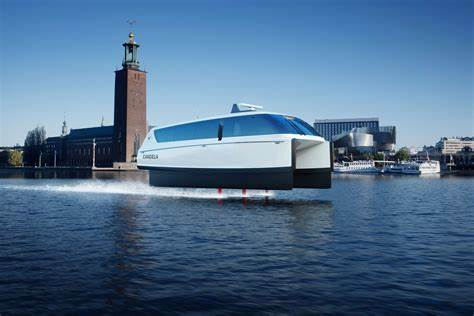
Above Candela P-12, (Image: Candela)

The new "flying hydrofoils" like the Swedish "Candela" can rise high above waves. That technology allows for a decrease in energy use and pollution. Electric hydrofoils use so-called passive hydrofoil technology. There the speed of the craft raises the hull above the sea on the wings, which are similar used in aircraft. 

Interesting visions this kind of craft can also operate using air propellers or even jet engines. Jet engines give those hydrofoils incredible speed. Those flying hydrofoils of high-lifting hydrofoils can use even rocket engines to give power. And that makes them interesting and an alternative for many missions. 


However, there is a possibility to make a hybrid hydrofoil. That connects wing-in-ground WIG technology with regular aircraft and hydrofoils. The variable wing geometry (VWG) makes it possible to create wings that can turn under the aircraft. The aircraft can operate as a hydrofoil, WIG aircraft. And as regular, high-flying aircraft. In some plans, the aircraft pushes the hydrofoils from below them. The DARPA concepts are not so radical. But the Liberty Lifter is interesting. 


One thing that caused the failure of the "Caspian Sea Monster" was the noise. It's possible. The next-generation flying boats can use regular boat propellers to travel outside the harbor. And those systems can travel to the outer sea before they start their jet engines. If the craft can have the possibility to act as hydrofoil. It can use regular blowers to travel short distances. And that ability makes that kind of system possible to travel far enough that the jet engines will not disturb people. 


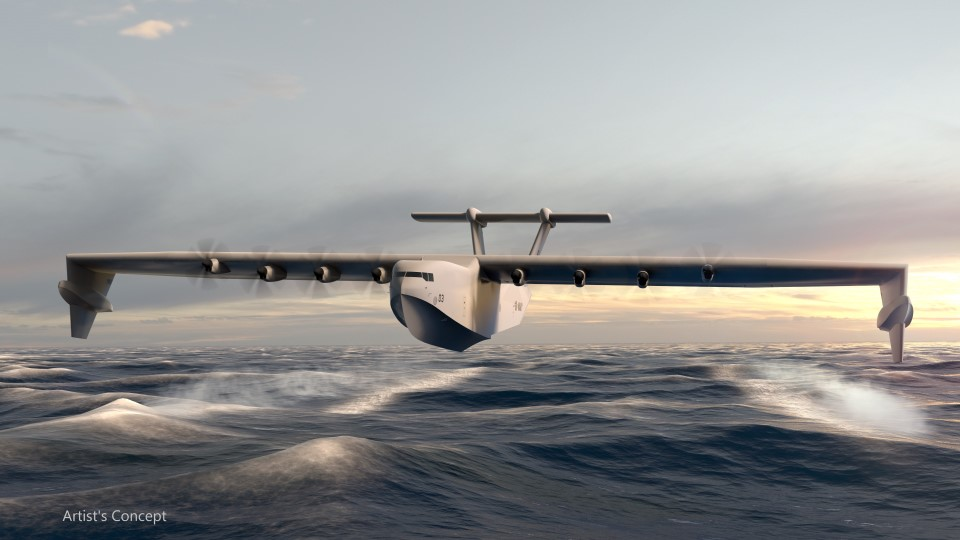
"Artist's concept of Aurora Flight Sciences' design" (Darpa.mil, Liberty Lifter)


The DARPA's new "Liberty Lifter" program is based on the Cold War-era Soviet WIG designs. Those flying boats use the WIG technology, but the difference between the famous "Caspian Sea Monster" is that the Liberty Lifter has longer wings. The Caspian Sea Monster's short wings limited its operations above the sea. The Liberty Lifter can operate as a regular aircraft and flying boat. As well as WIG aircraft. And maybe as a hydrofoil. When Liberty Lifter carries extremely heavy cargo it can use the WIG or hydofoil mode.  


"A rendering of a General Atomics' Liberty Lifter proposal (Wikipedia, Liberty Lifter)


Those things are next-generation tools for cargo, people transportation, and military purposes. Flying boats that use hydrogen can have internal electrolysis chambers. And that system can get electricity from any electric source. 

Large-scale flying boats can also operate from regular airfields. But amphibious mode makes it possible to operate from coastal areas even if there are no airfields. Those systems can operate in anti-ship, anti-submarine, and even in regular bombardment missions. That means they can carry the same weapon systems as some strategic bombers. So they can have the same nuclear strike capacity as B-52. And that makes those systems interesting. 


https://candela.com/


https://www.darpa.mil/program/liberty-lifter


https://en.wikipedia.org/wiki/Caspian_Sea_Monster


https://en.wikipedia.org/wiki/Liberty_Lifter

Six clicks separate people from each other.

“A long-observed social phenomenon suggests that people across the globe are separated by surprisingly few connections. Credit: Stock” (Scit...