Monday, May 8, 2023

If you are different than others, people remember you.


The worst thing that can happen in working life is that the boss will not notice the worker. There is a possibility that if the boss ever gives responsibility to some henchman that causes the end of the career. The person ever has changed to show the skills. And that can destroy the career. The best way to be nobody is just to wear grey or colorless clothes, hide behind some computer screen and hide your face. Things like attempts to be just like others mean that the boss has 15 similar persons who have the same skills. 

If we want to get promotions, we should make the boss see that "we are the guys" who that person wants to hire. In that process, we should convince the boss that nobody can beat us. Nobody is better than we are. And then, almost finally, the boss must think that we are the guy, who that person wants to hire, and we have something that the boss cannot find from anybody else. And that something must bring benefit for the company. That means we should make a positive and positively different impression on others. 

So being different positively means that the boss will focus attention on that person. And when the boss offers the possibility to show the skills that is a change. But at that point, the henchman should know what things to do. At that point causing disappointment can also destroy a career. 


But otherwise, the BBA will make coffee and just sits in groups and make nothing.  That thing can also cause pressure to kick that person away from the office. So before a worker will get any missions the problem is how to make the boss focus the attention on that person. Only if some person will focus attention on somebody, that is the change to get works, that can make an impression on a boss, who decides the person, who gets promotions. But first, the boss must focus attention on that person. 

That is the key element in the things like remembering. Our neural system is made for detecting differences and changes. If something looks different we look at that different-looking thing more easily than if the object is just like every other object. And we remember that thing better. If we have the same gender as other people. If we wear similar clothes that other people use, the leader's focus will not turn to us. 

The boss sees mass, and then that person will select the worker whose name will first come to mind. And that's the reason why in that case, the most affordable position for the person is owning a name that is as close to "A" as possible. If we all have similar backgrounds, including training, that makes us clones. And in that case is the same who the boss selects. But if we want to guarantee that boss will notice us, we should avoid colorless clothes. We should be positive and have a positive attitude. 

That means we should use so-called happy colors, and if we have red slips in meetings, that will guarantee that the boss will ask something. And that is a good moment to make an impression. But then we must realize, that if everybody has red slips, that thing makes that thing the mass again. 


https://scitechdaily.com/how-gender-and-race-can-make-you-forgettable/

Sunday, May 7, 2023

Origami robots.

Origami structures and advanced nanomechanics allow researchers to make robots. That can operate without microchips. Or even without electricity. 

The new origami robots use interesting nanomaterial. Some microchips handle boolean formulas. The nanomaterial follows the boolean logic commands like "AND", "OR", and "NOT". Each of those boolean logic commands determines the direction where those robots must go. The origami robots that are masterpieces of technology can make multiple things. The thing is that there are multiple microchips in the structure and each of those microchips can make different things because they are connected with different parts of that material. 

"By embedding flexible and electrically conductive materials into a pre-cut, thin polyester film sheet, the researchers created a system of information-processing units, or transistors, which can be integrated with sensors and actuators". (ScitechDaily.com/Origami Robotics: Scientists Push the Boundaries of Autonomous Capabilities)

"They then programmed the sheet with simple computer analogical functions that emulate those of semiconductors. Once cut, folded, and assembled, the sheet transformed into an autonomous robot that can sense, analyze and act in response to their environments with precision. The researchers named their robots “OrigaMechs,” short for Origami MechanoBots."  (ScitechDaily.com/Origami Robotics: Scientists Push the Boundaries of Autonomous Capabilities)

"An origami-inspired robot designed by a UCLA-led team that can reverse direction when either of its antennae senses an obstacle. Credit: Wenzhong Yan/UCLA" (ScitechDaily.com/Origami Robotics: Scientists Push the Boundaries of Autonomous Capabilities)


There is a possibility that some of the most futuristic robots are operating without microchips. The idea is that the complicated string-shaped molecules that are reacting to different types of stress like different sound frequencies. The thing is that the enzyme or protein springs can return to their original position by using the oppositely acting springs. And maybe in the future, some robots can operate without microchips by using outside stress. These kinds of robots can be very effective systems if they must travel in very high-power EMP fields. 

The wooden transistor is causing the idea that maybe things like cellulose fibers can act as transistors or microchips. But there is also the possibility that things like advanced memory materials also can use as systems that can control the robot's movements. There is the possibility that the robot's structure involves cellulose fibers and a series of protein and enzyme fibers that can resonate when an outsider actor will stress those protein enzyme fibers with certain radiation or soundwave with certain frequencies. 

In some models, a certain molecule that impacts those highly advanced materials will launch a reaction that moves the structure. The idea is that when certain chemical impacts those complicated structures it releases the string-looking molecule. The movements of those structures can be highly accurate if there is a series of string- and spring-looking molecules in the structure. 

https://scitechdaily.com/origami-robotics-scientists-push-the-boundaries-of-autonomous-capabilities/


https://webelieveinabrightfuture.blogspot.com/2023/05/swedish-researchers-made-first-wooden.html

Researchers created a 2D material that is 20 times harder than steel.

The new nanomaterial looks like graphene, but it's the covalent organic framework or COF. The structure of COF is similar to graphene. But it's easier to make. 

Graphene is a 2-dimensional single-atom layer of carbon. Graphite is a series of graphene towers. And that thing makes graphite a good source of graphene. But the problem is how to make enough graphene that it can cover some layers. The problem with 2D materials is that their abilities base the 2D structure.  If there is more than one atomic structure in 2D material. And that means that the material loses its abilities. 

So when the regular material will cover using 2D material. That 2D material must keep away from the layer.  Nanotechnical pillars, atom-size sticks, or DNA bites that act as springs can separate those 2D layers from each other. Those things used keep the 2D atom layer out of the shell.  Also if there is more than one 2D material layer. Those nano-pillars keep those structures separate. 

That allows researchers to make multi-layer nano-structures where 2D material can keep its form. The difference between graphene and COF is that COF is a polymer. And polymers can grow like crystals. It's easier to make the COF layer by growing the structure than by using graphene. The ability to grow the structure of the COF network makes it possible to cover large size areas. 


"Researchers have developed a method to retain the mechanical properties of 2D polymers called covalent organic frameworks (COFs) when stacked in multiple layers. By tweaking their molecular structure, the team created a lightweight material that is several times stronger than steel, preserving its 2D properties even in multilayered forms". (ScitechDaily.com/ Molecular Magic – Researchers Develop Lightweight 2D Material Stronger Than Steel)

"Potential applications include filtration membranes and upgraded batteries. The research could also impact the design of ceramics and metals, potentially enabling their manufacturing and repair at lower temperatures". (ScitechDaily.com/ Molecular Magic – Researchers Develop Lightweight 2D Material Stronger Than Steel)

Researchers describe the COF like this: 


"The potential applications are many. “COFs could make excellent filtration membranes,”. “For a filtration system, the functional group structure at the pore will be very important. As you have, say, dirty water traveling through a COF membrane, the functional group at the pore will capture the impurities only and allow the desired molecule to pass". (ScitechDaily.com/ Molecular Magic – Researchers Develop Lightweight 2D Material Stronger Than Steel)

"In this process, the mechanical integrity of that membrane will be very important. Now we have a way to design very strong, very fracture-resistant, multilayer 2D polymers that could be very good candidates for membrane filtration applications.” (ScitechDaily.com/ Molecular Magic – Researchers Develop Lightweight 2D Material Stronger Than Steel)


And by the way, the UFO story for the day.  The 2D nanomaterial can revolutionize space technology. 


In some visions, the developers planned to create a ball-shaped craft that is created by multiple layers of the 2D material. The idea is that the craft will use antimatter detonations for traveling. And the 2D material acts like ventilation. The idea is that there is no limit to the size of fullerene. The fullerene ball's size can be even kilometers. 

The system is two internal large-size fullerene balls, and the system adjusts the symmetry of the exhaust jet by using electromagnetic fields that are aiming it in the right direction. And that thing makes it possible to change its direction very fast. The 2D materials can also use in the rocket engine nozzles. And they can make the system less noisy. 

In some visions, the saucer-shaped space shuttle will equip with rocket engines that have graphene or some other 2D material net in the exhaust point of the nozzle. Then the very cold gas will pump in the exhaust gas that travels through that 2D network. That system makes it possible to create a silent and stealthy rocket that can be launched from near the city areas. 


https://scitechdaily.com/molecular-magic-researchers-develop-lightweight-2d-material-stronger-than-steel/

Saturday, May 6, 2023

Chinese researchers synchronized the monkey brain with a computer.

Chinese researchers made a big step in the development work of the BCI (Brain-Computer Interface). That step is the monkey brain synchronized with computers. And that thing makes the full-capable BCI systems possible. 

The BCI or EEG-controlled interface is not a new idea. Novelist Graig Thomas introduced that system in his SciFi novel Firefox in 1977.  In that book, the Soviet super-secret jet fighter used brain- or EEG-controlled weapon systems. The system used the modified electric shock system that communicated with the cortex. That was in the pilot's helmet. During that time. The BCI was one of the sci-fi-tales. But today, those systems are a reality. 

But things like machine learning and AI are making it possible to make those systems in real life. AI and machine learning are needed to separate certain EEG curves and then connect those curves with certain actions. The system must also filter white noise or meaningless thoughts away from the information that the system sends to the brain. 


The original development idea for the BCI system was to help ALS patients to communicate. The system allowed to use computers without touching them. Originally the system planned to use implanted microchips but today also hats with receiving electrodes are under development. The BCI control allows using of things like external bodies like service robots or HUCC-type robot skeleton that allows ALS patients to walk. 

But today also, military and civil authorities are interested in that system. It can use to control robots in extremely hard conditions. If the robot is connected to this system can use act as a gardener, but the same external body can use by medical doctors. The robot's body is the same all the time. But the user determines the robot's skills.


Researchers sometimes created an idea that they can use implanted microchips to control things like dogs and wolves. The BCI system decodes the brain signals and turns the animal into the robot that sends every sense to the controllers. 

The BCI can cooperate with machine learning. The thing is that the robot group or drone swarms can operate independently. But when they face too complicated a problem. Those systems can ask for human help. And then they store that solution in their memories for similar situations.

The BCI is like a mobile telephone. Who would believe in the 1970s that someday we have computers in our pockets? Who would believe those systems' capacity? 

Who would believe that in the 1970s that someday we have in our pocket the system that gives us access to information storage that is larger than any library in the world? Who would believe that we are looking at videos by using that system? The BCI can connect with the mobile telephone. And thing makes it the most multi-use system in the world. 


In the 1970's the  BCI was fantasy. 


But today, the BCI is seriously developing in public and secret laboratories. That thing allows users to control robots by using the EEG.  And that thing turns the robot into an external body for that system's user. The BCI system's user must not use hands or other limbs to control things like aircraft. 

That makes the aircraft capable to make higher G-turnings. The BCI can interconnect manned fighters with things like wingman drones that can have kamikaze missions like the ability to attack things like air-defense radars. 

The BAE aircraft corporation planning to install the BCI on the future Tempest II jet fighter. And there are also plans to control drone swarms by using augmented reality and BCI. Drone swarms of miniature drones also can use in surgical operations. But those systems are still the most effective weapons on the battlefield. 


https://interestingengineering.com/science/china-syncs-monkey-brain-with-a-computer

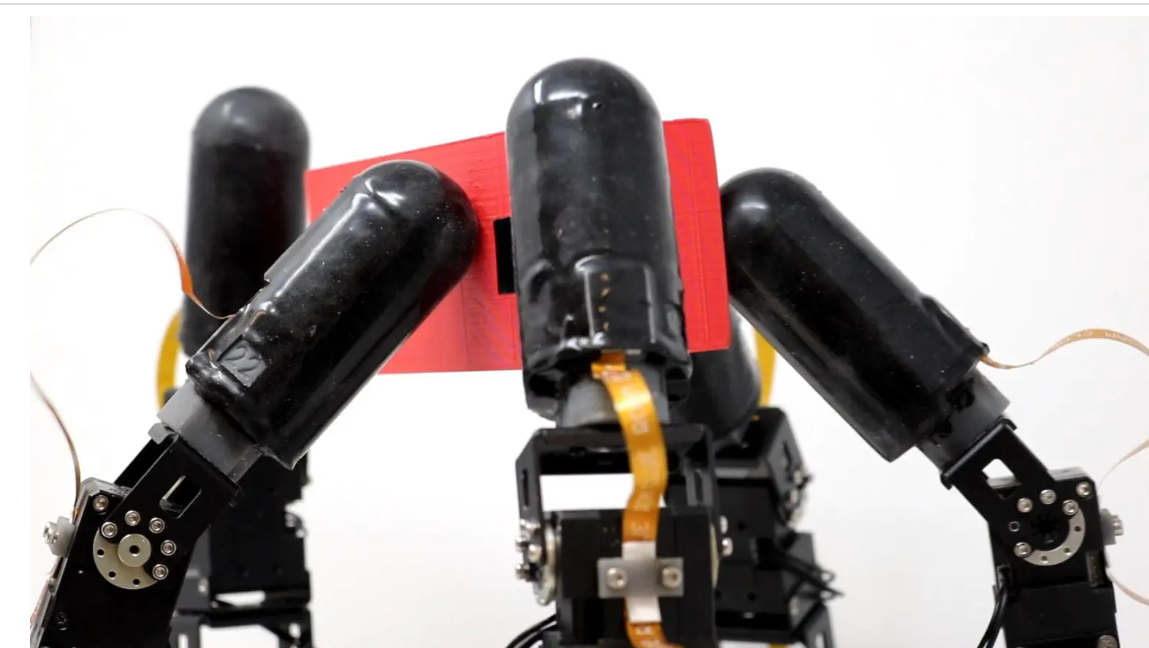
The new robot hand has a sense of touch.


The new robot hand can touch objects and move them without cameras. The system can operate in complete darkness and the difference between this new robot hand and the traditional systems is that the robot hand has a sense of touch. That sense is connected with machine learning. And the hand learns things that a regular person spends a year in one hour. 

This new robot hand can be the pathfinder for next-generation robotics with a sense of touch. Robots with that kind of thing might be more like humans. If a human-looking robot operates on the streets and visits shops and makes that kind of thing, it requires a sense of touch. If somebody touches that robt, it would recognize that thing, 

Robots with a sense of touch are interesting in many ways. They can operate in complete darkness without lasers, radars, and sonars. And that makes those robots stealthy. Because the passive sense of touch doesn't send any kind of signals, that system can move in darkness without sending any kind of sounds or unnecessary signals. 


"Using a sense of touch, a robot hand can manipulate in the dark, or in difficult lighting conditions. Credit: Columbia University ROAM Lab". (ScitechDaily.com/Columbia Engineers Create Highly Dexterous Human-Like Robot Hand That Can Operate in the Dark)


"Machine learning algorithms process the data from the tactile sensors to produce coordinated finger movement patterns for manipulation. Credit: Columbia University ROAM Lab" (ScitechDaily.com/Columbia Engineers Create Highly Dexterous Human-Like Robot Hand That Can Operate in the Dark)


"A dexterous robot hand equipped with five tactile fingers. One of the fingers is shown here with the outermost “skin” layer removed, to show the internal structure. Credit: Columbia University ROAM Lab" (ScitechDaily.com/Columbia Engineers Create Highly Dexterous Human-Like Robot Hand That Can Operate in the Dark)


The new robots with a sense of touch can also operate in narrow or dirty places. That means they are less vulnerable when they are covered by motor oil or some other dirt. But the passive sense of touch is one thing that can make many things safer. That thing can be connected with VR-based systems. And if it's connected to the brain. That allows it to send that sense remotely to the user. 

Machine learning makes that kind of system effective. Machine learning can operate independently. Or human users can make the movement series that the machine hand requires using data gloves. Then those series are stored in the memory of those systems. 

The sense of touch could be a practical tool in machines, security systems, and things like space suits and gloves. It allows the system to send that sense remotely to the human brain. And the user can feel the same thing that the robot feels. 

But what would you make with a car that has a sense of touch? That thing can decrease the damage while the car is driving in the parking lot. If a car touches another car the system will stop it. 

Things like futuristic nuclear submarines might have "skin" that feels the touch. That thing denies the ability to connect something like transmitters or detonators to the submarine's body. The sense of touch can also feel things like pressure impulses. 

In some visions, futuristic spacecraft also have a sense of touch. And that helps them to feel the micrometeorite impacts. If things like space suits' gloves have this thing, and they could transmit that signal to the human brain, that will make those things more flexible. Same way. When the operator operates robot hands by using data gloves the sense of touch can send the kinetic experience for the user. 

Swedish researchers made the first wooden transistor.

A new wooden transistor can revolutionize things like OI (Organoid Intelligence) and prosthetics. 


Swedish researchers made their transistors by using balsa wood. "In previous trials, transistors made of wood have been able to regulate ion transport only. And when the ions run out, the transistor stops functioning. The transistor developed by the Linköping researchers, however, can function continuously and regulate electricity flow without deteriorating". (ScitechDaily.com/Scientists Develop the World’s First Transistor Made of Wood)

"The researchers used balsa wood to create their transistor, as the technology involved requires a grainless wood that is evenly structured throughout. They removed the lignin, leaving only long cellulose fibers with channels where the lignin had been". (ScitechDaily.com/Scientists Develop the World’s First Transistor Made of Wood)

"These channels were then filled with a conductive plastic, or polymer, called PEDOT: PSS, resulting in an electrically conductive wood material". (ScitechDaily.com/Scientists Develop the World’s First Transistor Made of Wood).


The wooden transistor is the pathfinder for new bio-information technology. 


That conductive polymer can also use in other cells. There is the possibility that conductive polymer can with the leaves, and why not human cells? In animal cells, the long proteins can be used to make channels for that conductive polymer. The system can use an advanced bioprinter to make the tubes on the biolayer by using artificial blood or leaf veins. The system just uses cell cultures to make artificial veins and the printer just puts them on the layer that can be made of bone- or wood cells. 

And then the system can fill those veins by using electric conducting polymer. One of the most ideal components for electric transportation would be the salt water that allows for transporting electricity cheaply and effectively. That system can be useful in the microchip technology that returns the eyesight in damaged eye. 

There is a possibility that living, genetically engineered cells could create biopolymers where the salt makes an ionization that allows electricity to move in it. That thing might revolutionize the OI (Organoid Intelligence). Because it allows researchers to make more effective connections between living neurons and microchips. 


"Researchers at Linköping University, together with colleagues from the KTH Royal Institute of Technology, have now developed the world’s first electrical transistor made of wood. Credit: Thor Balkhed" (ScitechDaily.com/Scientists Develop the World’s First Transistor Made of Wood)

Transistors that are made of wood are the things that are making it possible to make microelectronic components by using biomaterials. The first wooden transistor might not look very elegant. But that is the pioneer product. And maybe very soon that thing can turn into a cell-size system that can make radios and other things biowaste. Organic microchips are things that can revolutionize security. 

The complicated miniature computers are made of materials that allow. To burn them or driving them to fertilizer makes data processing units that require high security more secure than they are now. If we think that things like bank cards are made using the same materials. That is used as food makes it possible that users can even eat those things like bank cards. 

Sometimes is planned to use leaves as the biological microchips. In those cases, the leaf's veins are filled with powder that turns them into electric components. And that thing can also be an electrically conducting polymer. And, other cells like bone- or skin cells can use to make the biological microchips. Those microchips can use to make artificial retinas for people. And they also can be used to control the prosthesis. Those microchips can use to control electric shock systems that give electric signals to transplanted limbs that increase their revert. 

The animal cells can make it possible to create the singularity where microchips installed on the skull cooperate with the Internet. The thing is that bone cells can also use to make miniaturized, biological microchips. 

The use of living cells as microchips makes one of the most interesting ideas possible. That thing allows to create the microchips that can install in the human body or skin. There is the possibility that the bone- or skin cells can also use for making next-generation biological microchips that can be put in the human body. Those things can use to control the computer by using EEG in the Brain-Computer Interface. The human body will not repel the systems if their makers use cells. That is taken from the receiver's own body when they produce the microchips. 


https://scitechdaily.com/scientists-develop-the-worlds-first-transistor-made-of-wood/

Friday, May 5, 2023

Australian defense department tries to create directed energy weapons systems that can destroy tanks.

The problem with tann-killing lasers is that their energy level must be very high. The laser ray destroys the target by increasing free energy inside it.  The problem is that tank is a very large object. And there is room for very high-level free energy. The most effective way is to create so big laser. That just closes the tank inside its ray. 

Microwaves or high-power radio wave systems can destroy targets, as well as laser rays. The area where that energy pumping system creates the free energy is important if the system can close the target inside the beam. It can raise the free energy level in the entire system. And that makes it easier to break the metal structure in armor. 

That thing denies the possibility that energy can conduct, away from the target's shell. The laser simply warms the tank. And when its energy pumping ends, the energy that travels out from the vehicle destroys it. The level of free energy is not the only thing that means something. Also, the area where free energy impacts the armor means something. 

The problem with the thin and powerful laser ray is it makes a hole in the tank. When the laser makes that hole it loses contact with the material. And then the system will not pump energy into the targeted material. If the system will aim a laser beam at an engine or ammunition, that thing breaks the mechanical parts or detonate ammunition. 


In some models, the system decreases the temperature of the target before it starts to warm it. The idea is that the infrared laser sends multiple high-energy pulses to the cold structure. And that thing causes a similar effect that destroys hot dishes on the table. 

The laser can pump lots of energy to the target, and then the liquid gas will drop its temperature. In some models, the system will simultaneously drop and increase the temperature in the target. That thing will break the structure immediately. 

The use of direct energy weapons against tanks is not a new idea. Sometimes is planned to use crossing radiowaves with opposite polarities. And some other plans included microwave weapons as potential tank killers.

Microwaves are acting like shotguns. And they can use to drop entire drone swarms at the same time.  The laser systems are used to shoot down drones and aircraft. The reason why laser is very effective against those small targets is that it doesn't need ammunition. That means it can shoot as long as there is electricity. 

Lasers don't need very much electricity if it creates its ray by using acetylene light. But if those systems are using electric light for making that ray, the source of that electricity doesn't mean anything. 

But the problem is that the tank is less vulnerable than light aerial vehicles. Another thing is that there are lots of metals in the tank that can conduct energy away from the impact point. So the system requires a very high-scale area that can create the free energy that destroys the material. 


https://interestingengineering.com/innovation/australia-anti-tank-lasers

The first drone that can reach an altitude of 10,000 meters is here.

“Meteomatics' Strato multicopter drone.” (Interesting Engineering) Swiss company called Meteomatics created a drone. It reaches an altit...